
Productscpzx

1. Product Introduction
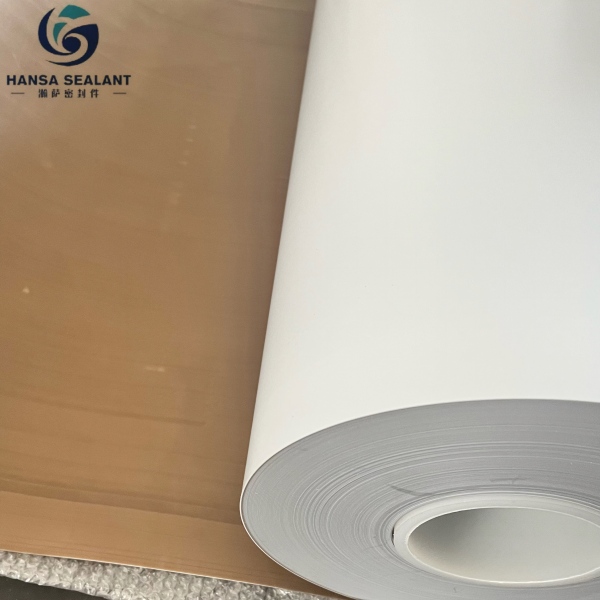
Single-side sodium-etched PTFE film, also known as single-side activated PTFE film or etched Teflon film, is based on pure polytetrafluoroethylene film. Only one side is chemically modified by naphthalene-sodium complex solution. The untreated side retains the original inert and non-stick properties of PTFE. The sodium-etched side forms an extremely thin active carbonized layer, which appears tan-brown. It solves the pain point of ultra-low surface energy of virgin PTFE that cannot be bonded, and can be firmly laminated with dissimilar materials such as metal, epoxy resin, rubber and glass fiber. The internal substrate performance of the film is not affected by modification.
Main production methods:
1). Roll-to-roll continuous sodium etching (mainstream for mass production)
Virgin PTFE skived / stretched film is unwound. Protective masking film covers the non-treatment side. Naphthalene-sodium etching is carried out under nitrogen atmosphere, followed by multi-stage cleaning to remove residues, low-temperature drying and light-shielding rewinding. Suitable for large-volume rolls with good treatment uniformity.
2). Batch immersion method (for small-batch sheets)
Cut film pieces are masked on one side, immersed in naphthalene-sodium solution for scheduled activation, then cleaned, dried and inspected. Suitable for small-size and sampling orders.
Principle: The strong reducing agent naphthalene-sodium removes fluorine atoms from surface C-F bonds to generate anchor layers with active carbon groups. The activation depth is generally 0.1~5 μm and will not penetrate the film.
2. Physical & Chemical Properties
| Item | Specification | Remarks |
| Density | 2.10~2.30 g/cm? | Pure PTFE substrate |
| Continuous Operating Temperature | -180℃ ~ +260℃ | Instant peak up to 280℃ |
| Surface Tension (etched side) | 50~62 dyne/cm | Untreated side: only 18~22 dyne/cm, non-bondable |
| Peel Strength (bonded with epoxy adhesive) | ≥1.2 N/mm | Tested per ASTM D903; premium grade reaches 1.6~1.8 N/mm |
| Tensile Strength | ≥25 MPa | Oriented film: 40~50 MPa |
| Elongation at Break | ≥200% | Flexible for die-cutting and lamination |
| Dielectric Strength | ≥15 kV/mm | Excellent electrical insulation |
| Coefficient of Friction | 0.05~0.1 | Untreated side: self-lubricating, low friction |
| Chemical Resistance | Resistant to strong acids, alkalis, oxidants and organic solvents | Only surface layer modified; substrate remains corrosion-resistant |
| Water Absorption | <0.01% | Almost non-absorbent |
| Thermal Shrinkage (150℃ / 30min) | ≤0.8% | Thinner films require stricter temperature control |
| Shelf Life | 3~6 months (sealed & light-protected) | Activity decays quickly under light and humid conditions |
| Flame Rating | V-0 | Non-flammable, self-extinguishing |
3. Typical Application Fields
| Industry | Application Scenarios | Value |
| New Energy | Fuel cell bipolar plate sealing, lithium battery insulating composite gaskets, energy storage module thermal insulation | Etched side bonds to metal/plastic; the other side provides corrosion resistance & insulation |
| Electronics & Electrical | High-frequency PCB laminating release film, cable insulation gaskets, sensor insulating pads, LCD composite components | Low dielectric constant, high temperature resistance for high-voltage & high-frequency insulation |
| Chemical Anti-Corrosion | Lining composite layer for reaction vessels, pipeline gaskets, bonded lining for anti-corrosion equipment | Bonded to steel substrate to isolate corrosive media |
| Mechanical Sealing | Wear-resistant sliding blocks, guide composite pads, pump & valve sealing gaskets, buffer wear layers | One side adheres to base part; the other side provides self-lubrication and wear resistance |
| Aerospace | Onboard thermal sealing parts, instrument insulating composite components | Stable over wide temperature range, ageing resistant and lightweight |
| General Industry | High-temperature adhesive tape base, die-cut gaskets, anti-slip wear pads | Cost-effective alternative to double-sided etched film; one side keeps non-stick release performance |
4. Selection & Design Guide
Selection Rule: Bonding side = sodium-etched side; release / wear-resistant side = untreated white side. Match thickness, substrate type, peel strength and temperature resistance first. Thin grades are suitable for flexible lamination; thick grades for structural supporting wear parts.
Main Grades & Dimensions
| Grade | Substrate Type | Thickness Range | Standard Width | Recommended Use |
| HS-ET05 | Unoriented skived film | 0.05 mm | 100/300/500 mm | Flexible tape, thin insulating gaskets, PCB laminating |
| HS-ET10 | Unoriented skived film | 0.10 mm | 100~1000 mm | New energy sealing, electronic die-cut parts (most popular) |
| HS-ET20 | Semi-oriented PTFE film | 0.20 mm | 100~1000 mm | Wear-resistant composite pads, medium-load sealing |
| HS-ET30 | Oriented stretched film | 0.30 mm | 100~800 mm | High tensile strength, low-shrinkage laminated parts |
| HS-ET50 | Thick skived film | 0.5 mm | 100~800 mm | Mechanical sliding blocks, anti-corrosion lining plates, structural gaskets |
Selection Notes
1). Adhesive Compatibility: Epoxy and PU adhesives are preferred. Anaerobic adhesives and common pressure-sensitive adhesives deliver poor bonding performance; sample testing is strongly recommended in advance.
2). Etch Depth: 0.5~1.2 μm for high-cleanliness electronic applications; 1.5~3 μm for thick gaskets and anti-corrosion parts.
3). Thickness Tolerance: Standard ±0.02 mm; high-precision version ±0.005 mm available.
4). Delivery Form: Rolls, sheets and custom die-cut parts. RoHS & REACH certificates can be supplied.
5. Usage & Maintenance
5.1 Storage
? Store in light-proof, dry, sealed and cool conditions with aluminium foil vacuum packaging. Avoid UV light and moisture.
? Recommended storage temperature: <25℃, humidity <60%. Use up quickly once opened.
? Do not expose the etched side to water or alcohol solvents for a long time; active layer will degrade rapidly.
5.2 Bonding
? Cleaning before bonding: Wipe the etched side gently with anhydrous ethanol. Do not soak or scratch the active layer with strong solvents.
? Follow adhesive curing profile fully. Curing temperature shall not exceed 260℃.
? Distinguish two sides: tan-brown side = bondable etched side; white virgin side = non-stick wear-resistant side.
? Test surface tension with dyne pen before bonding to confirm activity.
5.3 Processing & Maintenance
? Die-cutting, slitting and punching are available. Use sharp cutting tools to prevent edge fuzzing.
? Continuous service temperature of finished composite parts shall not exceed 260℃; keep away from open flame.
? Failure judgment: If dyne test drops or peeling happens easily, the etched layer is invalid and cannot be used.
5.4 Safety Notice
? The raw sodium etching solution is hazardous chemical. Finished film has no free sodium ions and is safe for normal handling. Waste liquid is closed-loop controlled by the manufacturer.
6. Development Trends
6.1 Ultra-low ion & high-purity grades: For semiconductors, hydrogen fuel cells and solid-state batteries, strict limits on sodium and metal ion leaching are required. Low-precipitation sodium etching process becomes mainstream for high-end applications with ICP-MS testing.
6.2 Green process alternatives: Traditional naphthalene-sodium etching provides high bonding strength but is under strict hazardous chemical regulation. Plasma and laser activation serve as complementary options for medium & low-load scenarios.
6.3 Higher consistency & tighter tolerance: Lithium battery and high-frequency PCB industries demand better thickness uniformity and even etching. Automated closed-loop production lines gradually replace batch processing.
6.4 Integrated functional composites: Pre-coated high-temperature adhesive and PTFE-fiberglass composite etched films reduce secondary processing for customers.
6.5 Accelerated domestic substitution: High-end fluoropolymer films are shifting from import to local supply, with coordinated material testing and process support.
7. Market Expansion
7.1 Hydrogen energy industry: Fuel cell stack sealing and bipolar plate composite insulation, the fastest-growing segment.
7.2 5G & high-frequency communication: High-frequency board lamination release film, high-speed cable insulation, leveraging low dielectric constant and bondability.
7.3 Pharmaceutical & semiconductor equipment: High-purity anti-corrosion gaskets and chamber seals with rising demand for high cleanliness.
7.4 Automotive lightweighting: Wear-resistant sealing composite parts for new energy vehicle braking and cooling systems.
7.5 Differentiated niche markets: Single-side etched film enjoys cost advantage over double-side etched film for structures requiring one release side and one bonding side, gradually replacing some double-side activated materials.
7.6 Extended service: Suppliers provide bonding guidance, adhesive matching and ageing validation, shifting from material sales to integrated material solutions.
8. Summary & Conclusion
Single-side sodium-etched PTFE film is one of the most important surface-modified PTFE products. It retains the full advantages of PTFE including wide temperature resistance, chemical resistance, insulation and self-lubrication, while only one side is activated for bonding. The design achieves “one side fixed by adhesion, the other side performing Teflon functions”, solving the inherent limitation of non-bondable virgin PTFE.
With stable naphthalene-sodium chemical activation technology, it is widely used in new energy, electronics, chemical, mechanical and aerospace high-end sealing and insulation applications. However, the activated layer has limited shelf life, and storage plus bonding procedures greatly affect final reliability. Going forward, as downstream new energy and semiconductor industries upgrade continuously, low-ion, high-uniformity and green-process single-side sodium-etched PTFE film will unlock larger market potential, while raising higher requirements on suppliers’ quality control, testing and process support capability.


