
Productscpzx

1 Product Introduction
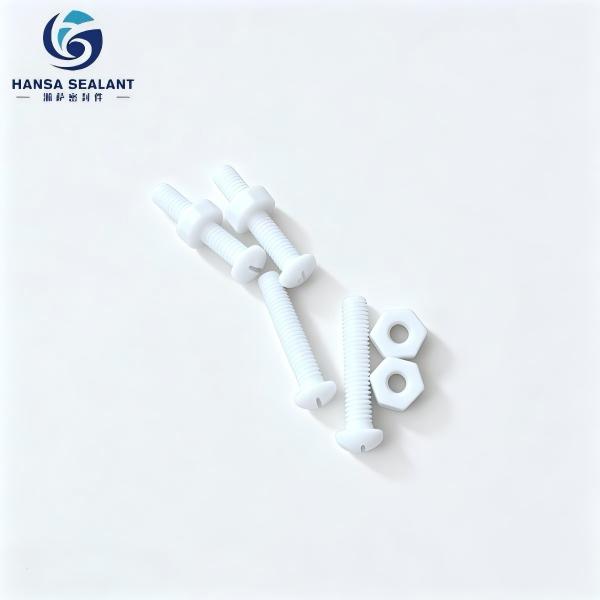
PTFE pan-head cross-recess screws and matching nuts are non-metallic fastening components mainly made of virgin polytetrafluoroethylene (PTFE). The assembly consists of pan-head cross-recess screws and PTFE nuts of the same material. The pan-head (round head with large bearing surface) structure delivers a large contact bearing area and resists crushing of connected parts. Standard cross recesses on the screw head fit universal cross screwdriver bits for convenient assembly and disassembly. Free of metallic content, this fastener set is designed for special working conditions such as heavy-duty corrosion, high-purity cleanliness, electrical insulation, and wide temperature ranges. It can replace metallic and general-purpose engineering-plastic fasteners and resolve problems including corrosive penetration, metallic ion leaching, electric short-circuiting, and signal interference.
2 Physical and Chemical Properties
The values in the table below represent typical reference data for virgin PTFE. Actual performance may vary slightly depending on raw-material grade, filler system, manufacturing process, and part dimension. The table also illustrates practical implications for service conditions.
| Property Category | Typical Indicator / Parameter | Test Standard & Remarks | Service-Condition Implication |
| Density | 2.14-2.20?g/cm? | ASTM D792 / ISO 1183 | Dense material with moderate specific gravity for lightweight non-metallic fastening |
| Service Temperature | Continuous operating temperature: -190?℃ to +260℃; melting point approx. 327?℃ | Long-term upper service limit: 260?℃ | Suitable for cryogenic and moderately high-temperature environments; no brittle fracture at low temperatures and low tendency for deformation at high temperatures |
| Chemical Corrosion Resistance | Resistant to strong acids, strong alkalis, aqua regia, most organic solvents, and powerful oxidants; only attacked by molten alkali metals and high-temperature active fluorinating media | Chemically inert; no swelling or reaction upon long-term immersion | Long-term service in corrosive media without rusting or chemical participation |
| Insulation Performance | Volume resistivity >10???Ω·cm; dielectric constant approx. 2.1 (10?-10??Hz); dielectric strength approx. 48?kV/mm; arc resistance ≥300?s | ASTM D257 / D150 / D149 | High-insulation and non-magnetic; prevents electric leakage, short-circuits, and high-frequency signal interference |
| Mechanical Properties | Tensile strength approx. 20-30?MPa; elongation at break >260?%; Shore D hardness 50-65 | ASTM D638 / D2240 | Possesses certain toughness and elasticity yet relatively soft; intended for light-load fastening |
| Friction and Self-Lubrication | Static friction coefficient 0.08-0.10; dynamic friction coefficient 0.06-0.08 | ASTM D1894 | Low friction and anti-seizure; resists galling during assembly and disassembly; no additional grease required |
| Moisture Absorption | Water absorption <0.01?% | ISO 62 | Dimensional stability; no water-induced swelling; compatible with clean and humid environments |
| Flame Retardancy and Weathering | Flame-retardant rating UL94 V-0; UV-resistant and ageing-resistant | UL94 | Self-extinguishing upon removal of flame; resists pulverization and cracking for long-term outdoor service |
| Biocompatibility and Cleanliness | Unfilled base resin free of additives; tolerates steam, ethylene-oxide, and gamma-ray sterilization | Food-contact and biocompatibility assessments available on request | Low adsorption and low impurity release; suitable for pharmaceutical, medical, and food-processing applications |
| Service Limitations | Susceptible to cold-flow creep; tensile and impact strength inferior to metals and PEEK; dimensional accuracy constrained by machining | Permanent relaxation may occur under sustained compression | Not suitable for heavy-load, impact-bearing, or high-tension conditions; select carefully according to operating conditions and retorque periodically |
3 Typical Application Fields
| Application Field | Typical Service Scenarios | Functions and Values |
| Chemical / Electroplating / Environmental Protection | Pickling tanks, etching production lines, pumps and valves, pipe fittings, waste-gas and waste-water treatment equipment | Withstands acid-base corrosive media; avoids fracture caused by fastener corrosion; reduces equipment downtime and maintenance frequency |
| Semiconductor / Photovoltaic | Wet-cleaning equipment, etch chambers, wafer carriers, silicon-wafer-handling tooling assemblies | Eliminates metallic-ion leaching and particulate contamination; guarantees process cleanliness and product yield |
| Medical / Pharmaceutical | Medical devices, analytical instruments, liquid-medicine pipelines, sterilization-equipment assemblies | Chemically inert; withstands repeated sterilization; prevents liquid-medicine contamination and adverse reactions with human tissues |
| Aerospace / Military / Electronics | On-board instruments, precision meters, radio-frequency components, insulating isolation assemblies for sensors | Non-magnetic, insulating, and resistant to wide temperature cycling; maintains reliable fastening under harsh conditions |
| Food / Beverage Processing | Production-line equipment, handling tooling, trough-accessory assemblies | Complies with food-contact safety requirements; non-stick surfaces for easy cleaning and disinfection |
| Electrical / High-Voltage Equipment | High-voltage insulating supports, insulating fasteners, cabinet internal assemblies | Provides electrical isolation; inhibits electric leakage and creepage; stabilizes electrical signals |
| Laboratory and Analytical Apparatus | Laboratory corrosion-resistant devices, reagent containers, analytical-instrument components | Chemical inertness ensures specimens and reagents remain free from fastener-originated contamination |
4 Selection and Design Guidelines
This chapter supports preliminary product matching for customers. Prior to final selection, comprehensively verify against actual load, contacting media, operating temperature, insulation and cleanliness requirements, assembly envelope, and regulatory-certification constraints. Specifications in tables below are metric reference values; final dimensions shall conform to drawings, samples, or confirmed purchase orders.
4.1 Reference Standards
? Screws: Refer to ISO?7045 / DIN?7985 pan-head cross-recess screws (metric coarse-thread series).
? Nuts: Matching metric coarse-thread PTFE hex nuts of equivalent sizes.
? Non-standard head styles, lengths, thread profiles, and surface treatments are available per customer drawings.
4.2 Material-Grade Selection Reference
| Material / Grade Type | Performance Characteristics | Recommended Service Scenarios |
| Virgin PTFE | Optimum chemical resistance, high purity, low leaching | Strong-acid / strong-alkali environments, high-purity manufacturing processes, medical-pharmaceutical applications, food-contact service, general-purpose anti-corrosion insulation |
| Carbon-Fiber-Filled PTFE | Improved wear resistance, stiffness, and creep resistance | Locations subject to repeated assembly-disassembly, friction, and moderate compression |
| Glass-Fiber-Filled PTFE | Enhanced dimensional stability and compressive-deformation resistance | Light-load assemblies requiring tight dimensional tolerances |
| Graphite / Bronze-Filled PTFE | Enhanced thermal conductivity and wear resistance | Conditions involving frictional heat generation and moderate heat-conduction demands |
| Sodium-Etched Surface-Treated PTFE | Improved surface bonding and print adhesion | Components to be bonded with adhesives, coatings, or dissimilar substrates |
4.3 Quick Selection Guidance
? Prefer PTFE: Strong-acid / strong-alkali and hydrofluoric-acid environments, high-purity zero-leaching requirements, electrical-insulation needs, repeated sterilization, and light-load assemblies under wide-range temperature cycling.
? PTFE is not recommended: Sustained high tension, impact loads, and heavy compressive loading. For such conditions, evaluate high-strength engineering-plastic fasteners such as PEEK.
? For elevated wear and creep resistance: Prioritize carbon-fiber-filled, glass-fiber-filled, or other modified-PTFE grades.
? For bonded assembly: Select single-sided sodium-etched PTFE fasteners.
5 Operation and Maintenance
5.1 Assembly Instructions
? Control tightening torque: PTFE is relatively soft; apply low tightening torque. Prefer PTFE flat washers to distribute compressive stress. Excessive torque causes thread stripping, thread cracking, or pan-head crushing.
? Assembly method: Suitable for manual tools or low-speed electric screwdrivers. Hammering and impact-driven installation are prohibited to avoid high-speed frictional heating and debris generation.
? Material compatibility: Assemble complete sets of PTFE screws and nuts whenever possible. If mating with metallic components is unavoidable, implement isolation measures to prevent galvanic corrosion and thread galling induced by differential thermal expansion.
? Thread cleanliness: For high-purity applications, ultrasonically clean threads prior to assembly. Do not abrade threads with hard steel brushes, as this generates particles and damages thread profiles.
5.2 Operation and Maintenance
? Periodic inspection and retorque: Owing to PTFE cold-flow creep, inspect and retorque according to equipment service cycles for assemblies under sustained compression, elevated temperature, or vibration to prevent loosening.
? Temperature-limit control: Continuous long-term service temperature shall not exceed 260?°C. Excessive temperature accelerates creep and thread relaxation.
? Storage requirements: Store in dark and dry conditions; avoid long-term stacked compression. For clean-grade products, prevent dust and contamination and preserve batch traceability.
? Failure mitigation: Adopt appropriate torque settings, flat washers, and matched same-material assemblies to effectively mitigate thread stripping, galling, corrosion, and particulate-induced failure, extend component service life, and reduce spare-part costs and equipment downtime.
6 Summary and Conclusion
Benefiting from outstanding chemical inertness, wide-range thermal stability, high insulation performance, low-friction self-lubrication, and low-leaching characteristics, PTFE pan-head cross-recess screws and matching nuts constitute a light-load fastening solution for demanding conditions of heavy corrosion, high-purity cleanliness, electrical insulation, and broad-temperature-range operation. Compared with metallic fasteners, they eliminate rusting, metallic-ion leaching, and electrical-signal interference. Compared with ordinary engineering plastics such as PVDF, PPS, and nylon, they deliver broader chemical compatibility and higher temperature resistance.
It should be noted that virgin PTFE exhibits relative softness and cold-flow creep and is not suitable for heavy-load, impact-bearing, or high-tension applications. For such scenarios, modified PTFE grades or alternative materials such as PEEK shall be evaluated. We supply virgin-material standard parts, filled-modified components, non-standard custom sizes, and surface-treatment services. Together with standardized torque and assembly-maintenance recommendations, our offerings help customers improve assembly efficiency and reduce component-failure losses and equipment downtime.


